Saturday, September 21, 2013
African Safari
When on safari in the African bush (in this case in the Kruger National Park) being alert is part of life - as these 2 Impala antelopes demonstrate.
However certain sightings can be deceiving - especially if obscured by tall grass - is what we see a so-called camelopardalis?
Sticking out it's tongue after lifting it's head - confirming that it is indeed a Giraffa camelopardalis, which refers to a giraffe's camel-like as well as leopard-like appearance.
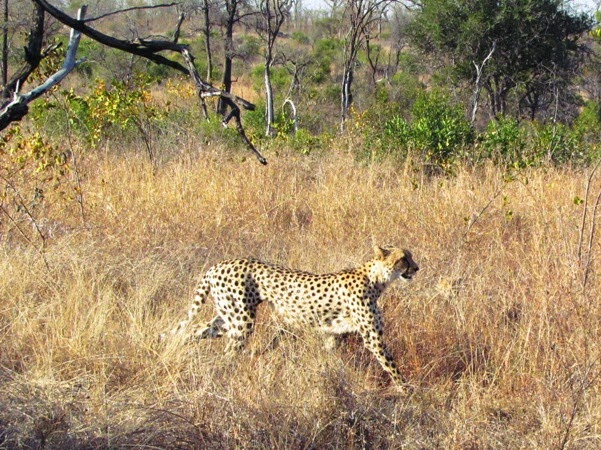
At first glance some of the visitors in the open safari vehicle (driving through the Kruger National Park) thought a leopard was "joining" us - however it was a female cheetah . . .
. . . with some very cute youngsters in her wake.
On the prowl was a "mean"- looking spotted hyena . . .
. . . although when lying relaxed on a sandbank one can't help comparing otherwise sinister hyenas with domestic dogs - although strangely the name 'hyena' is derived from the Greek word for 'pig' (probably referring to its eating habits!?)
Last but not least - a lion is usually on the "wishlist" of most visitors on an African safari - in this case a young male guarding its prey: an old buffalo.
Thursday, August 29, 2013
Only in Africa
Only in Africa . . . can you drive through a National Game Reserve and expect to see the BIG 5 - crossing the road/walking next to your vehicle/appearing tame but actually being (completely) wild!!!
NO Zebra-Crossing but instead yet another 1 of the (famous) BIG 5 "blocking" traffic - which can only happen in Africa.
Take a good look through the window of your vehicle - yes, that's another 1 of the BIG 5 grazing peacefully right next to the road.
Number 4 of the BIG 5 - what a pleasure if you can find all of them on 1 day whilst driving leisurely through a park.
And there he/she is = Number 5!!! [Click on photo to enlarge and check bottom-right of photo] - this leopard was REALLY ANNOYED - just like us in a vehicle STUCK in a horrible traffic jam because some IDIOTS "hogged" the road/prevented all other vehicles to pass in an "orderly" fashion - "shout out" if you've experienced a similar situation before in a game reserve in Africa.
And to "calm down" again - Number 6 of the BIG 6!!! Yes, it's whale-season again (until about November) and the Southern Right whales can be found all along the southern African coast - and yes, again, South Africa is now known as a BIG 6 country - no, sorry, make that the BIG 7 - but I have no personal photos of Number 7 [Check my previous blog-entries to see "who" is the 7th member] - it's no mystery, just one way of me expressing WHY I LOVE living in Africa ;)
Saturday, June 29, 2013
For Residents Only
"Use of pool for residents only"!!
Swimming at own Risk
When in her element the female ignores the male . . .
. . . the male's ego has suffered so . . . time to flex his muscles - perhaps that will catch the female's attention?
In the mean time . . . at a hotel at another place . . .
. . . after "testing the water" both parents declare that the pool is safe for swimming . . .
. . . so now they have "all the ducks in a row" ;)
Sorry, was meant to say: all the little Egyptian geese in a row.
Friday, June 21, 2013
Who's your Daddy?
Had some fun & interesting responses on my FaceBook wall about this so thought of also sharing it here on my blog :)
I posed the Question - Who's your Daddy?
Answer - (perhaps) ET ??
It's all about a caterpillar I found in our garden (here in Port Elizabeth, South Africa) & wondered what it would "become" once it "grows up" !?
So here are: the many faces of .......
A caterpillar that looks like ...... a monster ??
That looks like ..... a crocodile ??
That looks like ..... a seahorse ??
That looks like ..... an elephant ??
Yes, certainly looks like an elephant but .......
......... when it does "grow up" it turns into a Hawk-Moth!!!!!!!!!
A weird & wonderful creature - had fun photographing it :)
I posed the Question - Who's your Daddy?
Answer - (perhaps) ET ??
It's all about a caterpillar I found in our garden (here in Port Elizabeth, South Africa) & wondered what it would "become" once it "grows up" !?
So here are: the many faces of .......
A caterpillar that looks like ...... a monster ??
That looks like ..... a crocodile ??
That looks like ..... a seahorse ??
That looks like ..... an elephant ??
Yes, certainly looks like an elephant but .......
......... when it does "grow up" it turns into a Hawk-Moth!!!!!!!!!
A weird & wonderful creature - had fun photographing it :)
Tuesday, May 28, 2013
Male Giraffe Behaviour
Despite its extreme length, a giraffe's neck is nonetheless too short to reach the ground/water or in this case a "salt-lick". Since I've discussed the difference in colour, patches and patterns of giraffe-coats before [SEE: previous blog-entries, esp during April 2013] today I want to concentrate on giraffe-facts, i.e. behaviour traits mostly "connected" to the giraffe's neck.
2 different giraffe the same "behaviour" (I photographed the giraffe above in the Pilansberg Game reserve whereas this giraffe "hails" from Namibia) - both look awkward as they have to spread their front legs in order to reach the ground.
During the same awkward-looking manoeuvre when reaching down to drink, a jugular vein contaning a series of 1-way valves prevents the back-flow of blood when a giraffe's head is bent down - this in fact prevents the giraffe from blacking out!
Another giraffe-way of reaching the water level to drink is to bend its knees (instead of spreading) . . .
. . . so these 2 drinking giraffe obligingly demonstrate both ways of reaching low at one-and-the-same-time :)
Since giraffe usually only sleep for approx 5 minutes, they tend to rest whilst standing up. However they sometimes do lie down on the ground to sleep, in which case a giraffe tucks its front legs under itself . . .
. . . and holds its head up (or curls its neck back to rest its head on its rump).
Giraffe can moo, his, roar or whistle - although that is rarely heard. However finding male giraffe using their necks as weapons in combat occurs regularly - this behaviour is known as "necking", which is employed to establish dominance.
During "low" intensity necking, the combatants rub & lean against each other; however during "high" intensity bouts the combatants swing their necks at each other, landing heavy blows.
After a duel it is common behaviour for the 2 male giraffe to caress & court each other, leading to mounting & climax. Such interactions between male giraffe was found to happen far more frequently than heterosexual coupling.
2 different giraffe the same "behaviour" (I photographed the giraffe above in the Pilansberg Game reserve whereas this giraffe "hails" from Namibia) - both look awkward as they have to spread their front legs in order to reach the ground.
During the same awkward-looking manoeuvre when reaching down to drink, a jugular vein contaning a series of 1-way valves prevents the back-flow of blood when a giraffe's head is bent down - this in fact prevents the giraffe from blacking out!
Another giraffe-way of reaching the water level to drink is to bend its knees (instead of spreading) . . .
. . . so these 2 drinking giraffe obligingly demonstrate both ways of reaching low at one-and-the-same-time :)
Since giraffe usually only sleep for approx 5 minutes, they tend to rest whilst standing up. However they sometimes do lie down on the ground to sleep, in which case a giraffe tucks its front legs under itself . . .
. . . and holds its head up (or curls its neck back to rest its head on its rump).
Giraffe can moo, his, roar or whistle - although that is rarely heard. However finding male giraffe using their necks as weapons in combat occurs regularly - this behaviour is known as "necking", which is employed to establish dominance.
During "low" intensity necking, the combatants rub & lean against each other; however during "high" intensity bouts the combatants swing their necks at each other, landing heavy blows.
After a duel it is common behaviour for the 2 male giraffe to caress & court each other, leading to mounting & climax. Such interactions between male giraffe was found to happen far more frequently than heterosexual coupling.
Sunday, May 19, 2013
Just for YOU
As promised - JUST FOR YOU (you know who you are) - the magnificent looking Noordhoek Beach just before Kommetjie along the Cape Peninsula.
At the same time I'm "using this opportunity" to post a few of the wild animals, which we encountered in the Kruger National Park during the last tour I guided (4-17 May).
Looks as if this buffalo wasn't amused by us disturbing him from feeding.
Is this female impala trying to say something?
Similarly this wildebeest appears to talk to us :)
Also not appearing amused this male warthog certainly is clearly "displaying" the 4 warts (on his face) from which it derives its name.
On our way out of this game park we "discovered" a few hyena habitually hiding their young in the drainage systems under many a road.
Friday, May 3, 2013
A Closer Look
In conclusion of the "debate" about the 2 uniquely African animals - to which subspecies (of giraffe or zebra) they might belong - I thought of concentrating on (or having a closer look at) their coat/fur/hide.
When comparing the fur of this giraffe (photographed in the Pilansberg Game Reserve) . . .
. . . with this giraffe's (photographed on a private game reserve in Namibia), the colour is very similar but the (pattern of the) spots is quite different.
In contrast this giraffe's spots are similar to those on the hide of the first-closer-look giraffe but the colour of the spots is entirely different (to those of the 2 above) . . .
. . . whereas the colour of the spots is similar between these 2 (last) giraffe hides (both photographed in the Etosha Game Reserve), the size of the spots vary - especially with regard to more whitish/beige hair "between" the spots on this giraffe's coat . . .
. . . and yet another slight difference is visible when comparing the furs of the last 3 giraffe (this giraffe was photographed in the Hluhluwe Game Park) . . .
. . . whereas colour-wise this giraffe (photograped in the Kruger National Park) is in a "class of its own" - yet geographically all of these giraffe should "belong" to only 1 of the 9 subspecies of giraffe found in Africa - the South African (or Transvaal) giraffe.
After a last closer look at the fur of a giraffe, let's take one more look at the numerous variations in the stripe-pattern of a typical Plains (commonly referred to as Burchell's) zebra - with its black flank stripes also covering the underparts, as well as the narrow (brown, yellow or grey) "shadow stripes" between the broad black rump stripes.
After some "resistance" at first, because I was under the impression that this is a different species instead of a subspecies of the Plains (Burchell's) zebra, I now believe that this is a Grant's zebra - even if there aren't any (visible) shadow stripes on the coat!!
In contrast I'm still not sure if we are looking at another subspecies of the Plains zebra, namely 2 Damara zebra - because they have (completely) white legs & were photographed in the Etosha Game reserve (where geological this subspecies is "at home") - OR if these are "real" Burchell's zebra (since according to some sources, the Burchell's is a subspecies of the Plains zebra) - this subspecies is also said to have NO stripes on the legs!!??
When comparing the fur of this giraffe (photographed in the Pilansberg Game Reserve) . . .
. . . with this giraffe's (photographed on a private game reserve in Namibia), the colour is very similar but the (pattern of the) spots is quite different.
In contrast this giraffe's spots are similar to those on the hide of the first-closer-look giraffe but the colour of the spots is entirely different (to those of the 2 above) . . .
. . . whereas the colour of the spots is similar between these 2 (last) giraffe hides (both photographed in the Etosha Game Reserve), the size of the spots vary - especially with regard to more whitish/beige hair "between" the spots on this giraffe's coat . . .
. . . and yet another slight difference is visible when comparing the furs of the last 3 giraffe (this giraffe was photographed in the Hluhluwe Game Park) . . .
. . . whereas colour-wise this giraffe (photograped in the Kruger National Park) is in a "class of its own" - yet geographically all of these giraffe should "belong" to only 1 of the 9 subspecies of giraffe found in Africa - the South African (or Transvaal) giraffe.
After a last closer look at the fur of a giraffe, let's take one more look at the numerous variations in the stripe-pattern of a typical Plains (commonly referred to as Burchell's) zebra - with its black flank stripes also covering the underparts, as well as the narrow (brown, yellow or grey) "shadow stripes" between the broad black rump stripes.
After some "resistance" at first, because I was under the impression that this is a different species instead of a subspecies of the Plains (Burchell's) zebra, I now believe that this is a Grant's zebra - even if there aren't any (visible) shadow stripes on the coat!!
In contrast I'm still not sure if we are looking at another subspecies of the Plains zebra, namely 2 Damara zebra - because they have (completely) white legs & were photographed in the Etosha Game reserve (where geological this subspecies is "at home") - OR if these are "real" Burchell's zebra (since according to some sources, the Burchell's is a subspecies of the Plains zebra) - this subspecies is also said to have NO stripes on the legs!!??
Subscribe to:
Posts (Atom)