 Was very busy lately planning/organising a tour for a couple visiting our country for the first time, but I didn't forget my promise to post some elephant-mother-&-child-photos. During the last tour in the Kruger National Park, we "happened upon" this scene of the females in an elephant herd "hiding" a few very young offspring in a thicket.
 Eventually the herd crossed the road ahead of us (sitting in open safari vehicles), & "last in line" was this female elephant with her newborn baby as well as her "attendants" (= other female elephants specifically around to assist the mother in protecting her vulnerable young offspring).
 By now people all over the world must have heard/know how amazingly protective & caring female elephants are with regard to their young - other than also towards each member within the herd. Yet even knowing this doesn't dampen a feeling of deep admiration every time one is privileged to "witness" such devotion.
 This is one of the very first photos I snapped with a small digital camera (instead of a camera-with-film) - of an elephant female with her youngster only moments after it was born!! - accompanied by another elephant baby probably only a day (or 2) old.
 Another photo of a female elephant crossing the road with her tiny youngster "in tow" - luckily for all visitors a quite regular occurance when driving through most of our game reserves.
 An elephant mother's trunk gently guiding her youngster towards safety instead of possibly getting into trouble, because this inquisitive, tiny young elephant isn't able yet to distinguish if what it has detected might endanger its existence.
 Another example how an elephant female uses her trunk to "guide" her youngster - in this case towards tasty acacia leaves.
 The song: "lean on me" - or is that: lean against me? - comes to mind. These 2 elephants were crossing the road after a refreshing mud-bath in a river nearby.

Last but not least today: another photo of mother-elephant & her tiny newborn, of which I posted a series of photos before (= An Elephant Story) on Tuesday, 25 October 2011.
Wednesday, March 21, 2012
Elephant Mother & Child


Sunday, March 4, 2012
Also Mother & Child

"In tune" with my previous blog-entry (= Mother & Child) I spotted this Moorhen-with-chicks during a recent visit to Birds of Eden (near Plettenbergbay). So I decided to continue that trend today by posting photos of "feathery" mother-and-child combinations - previously known as the Jackass penguin but now called the African penguin, with its tiny (sooty-black) chick.

A Crowned plover & chick.
A female Crested barbet feeding her chick.
Other than that its legs are "showing", not much else is visible of the little Blacksmith plover chick hiding against the rain that day under its mother's belly.
This female Egyptian goose appears confused - how did her flock of chicks end up in a human-swimmingpool?
Talking about a flock (instead of single) chicks - this female ostrich stands "guard" over her youngsters finding relief from the heat in the shade of an acacia tree (photographed in the Etosha Game Reserve, Namibia).
Similarly ostrich chicks find relief from the heat in the shade their father's large body casts across a desert-like environment if no trees are readily "available". Is this an example of taking a mother's caring attitude to "the limit"? A very noisy Diederik cuckoo chick (known as brood-parasitic, because many true cuckoos lay their eggs in the nests of other birds) demanding to be fed by its "brood"-mother (in this case a female weaver).
Thinking of sharing some Elephant-Mother-&-Child photos with next blog-entry.
Tuesday, February 14, 2012
Mother and Child

The well-known mother-and-child-theme appeared to "dominate" in nature during the last tour - in this case a female impala & her youngster.
Somewhat ugly but strangely mostly thought of as endearing by people "meeting" warthogs in nature, this was even more so the case with this mother & child. In actual fact this was the first mother-and-child-combination we observed at the start of the last tour - a female blesbok & its youngster "naturally" found only in the highveld-part of our country.

Another endearing mother-and-child-combination - a female Burchell's zebra & her offspring. . .
. . . which similarly, the other "typical" savannah-animals, giraffes, seem to take "a step further" by appearing to kiss - although in this case it's not a mother-and-child-combination, because the large giraffe (on the right) is a male. Another look at impalas, who in this case also appear to kiss (especially the couple in the background), whilst in fact it's a "demonstration" of mutual grooming = impalas are the only hoofed animals (in contrast to e.g. primates) that can partake in this survival skill.
Wednesday, February 8, 2012
Flood Damage
 Although we were lucky & able to enter the Kruger National Park during the last tour without much "hazzle", the damage caused by the recent floods (Jan 2012) was particularly "frightening" when crossing the high-level bridge across the Sabie River near the Skukuza camp . . .

. . . on closer inspection - the metal of the railing was badly damaged/bent . . .
. . . obviously by the force of the water "rushing" over the bridge - a very "sobering" thought.
Other than taking a photo of the damage left in the wake of the floods, I also snapped this scene to use as a "comparrison" . . . . . . between a "before & after" scenario - although before I thought of this scene as serene & beautiful & certainly didn't think of "including" the bridge-railing in a photo - check out the "new" water-course on the photo above.

Yet another look at more or less the same "spot" from the bridge - the only "constant" in all 3 photos is the large wild fig tree on the right side of the river.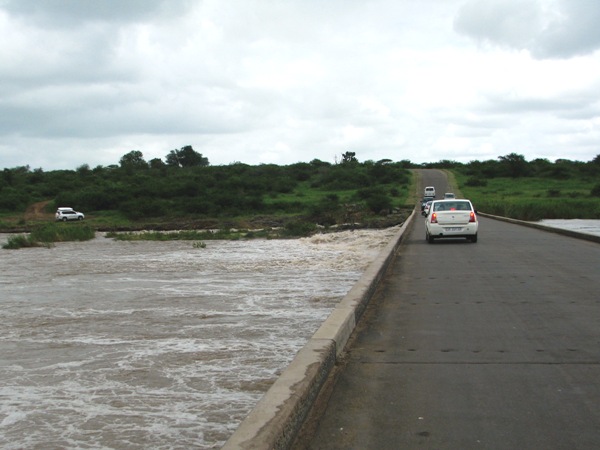 The most damage caused by floods in parts of the Kruger National Park probably was in February 2000, whilst this is what the Sabie River looked like at the bridge near the Lower Sabie camp on the 25th of Jan last year (in contrast to the above flood-damage-photos taken on 29 Jan this year) . . .

. . . or similar floods at this time of the year at the same bridge IF in the opposite direction (= travelling away from Lower Sabie) - this photo was also taken at more or less the same time (= beginning of the year) 2009, 4 February.
Wednesday, January 25, 2012
Flower Power
 Before I leave on my first tour (as a South African tourist guide) this (new) year & hopefully return with some "magic" photos, I want to share some exotic (NOT indigenous) flower-power. First up: an Azalea . . .

. . . & what I call a Potato creeper - I'm not sure if that is this plant's name!??
Luckily I have no problem identifying this large Sun flower . . .
. . . whilst (colour-wise) these are not very common red Amaryllis . . .
. . . a lily-white Water lily . . .
. . . & last but not least a nice pink Rose - probably the most easily recognised flower in the world??
Sunday, January 15, 2012
Thickbilled Weavers
 Again & again I returned to a pond filled with Bulrush (reeds) during our recent vacation at Hole-In-The-Wall [SEE: blog-entry below = 15 Dec 2011] because I had discovered that it was inhabited by a relatively large flock of Thickbilled weavers. Built solely by the male, the nest of a Thickbilled weaver is usually suspended between at least 2 upright stems of Bulrush (or other reeds).
 In contrast to the nests of most "true" weavers (of mainly yellow plumage) with their "bottom" entrances, the nest of a Thickbilled weaver has a larger, "side-top" entrance & looks like a domed cup.
 With amusement I watched this weaver chick appearing to be as curious as I was fascinated by its existence. 2-4 eggs in a Thickbilled weaver nest are incubated only by the female between 14-16 days.

A chick leaves the nest after 19-22 days, but at first is still fed by the female. I snapped a series of photos of this tiny Thickbilled weaver appearing barely able to "hang on" after obviously having just left its nest for the very first time . . .
. . . whilst 2 somewhat older chicks looked on/appeared amazed by the tiny one's "antics". Whilst this happened in a relatively silent manner . . .
. . . other chicks - precariously balancing on the bulrush - chirped loudly from hunger & to catch their mother's attention.
Occassionally a female Thickbilled weaver - similar in appearance to the youngsters - "made an appearance" . . .
. . . which seemed to appease the chicks, even if they weren't fed. After all the "excitement" the youngsters appeared to tire easily, so the chirping stopped for a while - only to resume the moment they sensed a female's pressence.
With a magnificent specimen (= male) on display, the following came to mind ("pronounced" by 1 of the chicks): When I grow up . . .
Thursday, January 5, 2012
Camouflage or Illusion
 I guess that from a human perspective these zebras are not really "blending in with their surroundings" (= camouflaged) but apparently predators - i.e. lions - are completely "confused" once zebras "bunch together". Like all cats, lions have a poor eyesight, especially during the day - so in this case, all a lion would see is stripes!

On the other hand these 2 Black-bellied korhaan are blending in with the environment & therefore are well-camouflaged.
Is this lioness well-camouflaged, i.e. blending in with the environment - or is it more a matter of colour-coordination?
A cheetah - simply well-hidden by long grass or well-camouflaged?
In the case of this small antelope - a duiker - colour functions as concealment = to deceive an enemy.
In contrast to all of the above, this is more a matter of illusion instead of concealment/ camouflage to escape detection - doesn't it appear as if the giraffe (on the right) is bending closer/kissing/licking the group of vultures "parked" at this watering hole?
To end this as it started = another look at a group of zebras "bunching" together/"displaying" a lot of stripes ☺
