 Often people are classified as being either black or white, but in the animal world, being black or white is often an "exception to the rule" - as is the case with these 2 ostrich chicks = 1 black, the other white.
Similarly this Llama youngster is "unusually" black-coloured. I "discovered" this little albino monkey in the vicinity of the Victoria Falls - and immediately "made" her the main character of my next book: Moni the Monkey
[My other "story with photos" is Impi the Impala - just check it out on: www.impi-impala.blogspot.com]
To my surprise I also recently detected an albino wildebeest (= a gnu) amongst a herd of Blue wildebeest in a Game reserve in Swaziland.
Another kind of exception to the rule is this springbok - it had accidentally slipped at a lime-rich waterhole & as a result, was covered in white mud!
In contrast this Black(!!) rhino had actually enjoyed a mud-bath at a waterhole in the Etosha Game Reserve (Namibia).
With its pink eyes this bunny also might be an albino!? . . .
. . . wheras this animal is neither white nor black - even if its legs are both black & white. It's generally known as a zonkey = a cross between a donkey & a zebra.
Friday, November 19, 2010
Black or White


Tuesday, November 9, 2010
At Close Quarters

After a very successful tour I've once again returned with some "distinctive" photos like this Vervet monkey - trying to hide or blend in with the environment?
On the subject of primates, which often reveal human-like mannerisms - ditto these Chacma baboons.
"Hold on tight!" seems to be the instruction to this baby baboon.
It's always a pleasure to see a family of graceful giraffes and fun to photograph if they represent such a "united front".
Tracking down all of the BIG 5 is no easy task when on a game drive, so the excitement when discovering one of the cat species, often "knows no bounds" - just ask the lady, who spotted this well-disguised leopard, how she reacted.
In contrast this otherwise habtually "shy" nyala male didn't seem to mind that we admired it - at such close quarters. Talking about nyalas - to this day, after taking thousands of animal photos, I still haven't been able to "capture" a nyala male & female "side by side" - although both "feature" in this photo. I "long" to do that mainly because this is the only one of our antelopes, where there's a marked difference in size between the male & female, so that in Enlish we call a nyala male a bull (not a ram), but a female nyala a ewe (= more or less the size of an impala antelope).
Saturday, October 16, 2010
Harmonious Nature

Giraffes are a general "feature" in most game reserves in our country - but one isn't always "blessed" with viewing them at such close courters, other than that they are "posing" so harmoniously . . .
. . . even when this "couple" turned their heads, they did it in harmony.
Similarly in harmony with nature was this young kudu male. When I became interested in "birding" I was convinced that identifying large raptors was an "easy" process - until I realised that especially eagles "go through" various stages of metamorphosis before "acquiring" their adult plumage . . .
. . . whilst without its mother by its side, I don't think I would have correctly identified the juvenile Bateleur (above). Talking about birding - after I set the goal of photographing as many bird species as posible & on reaching the "magical" number of 400, it's not easy "finding" a bird I haven't as yet "recorded". So it was exciting to "discover" not 1 but eventually 3 birds I wasn't able to photograph before - apart from this Gurney's sugarbird (in the Drakensberg area) I could also add a Purple gallinule (at the St Lucia Estuary) & a Yellowrumped widow (in the Hermanus/Gansbay area) to my bird "file".
 Turning to reptiles now - I have often photographed a Water leguaan (= a Monitor) although this one was "special" - I was actually sitting patiently behind a bush waiting for a Red duiker to emerge, when right in front of me I saw a movement. I was concentrating so much on the little antelope "hiding" that I had missed what was right there = this rather large reptile. How could I have missed it? It remained still, just checking "over a shoulder" if I represented a possible threat - which I must admit, I also contemplated - but in the end, taking "shots" of this animal won over any feelings of fear.
In contrast I haven't "met" many a Rock leguaan before - so finding this one crossing the road ahead of our open safari-vehicle was a "nice" surprise. Last but not least - a "smaller version" = a colourful Rock agama. As I've mentioned before when "discussing" members of the lizard family: rock agamas (when "posing" in a certain way) remind me of (miniature) dragons.
[Will only be able to post more photos in about 3 weeks time, because until then, I'm going to guide a group of German-speaking tourists through our highly diverse country again]
Sunday, October 10, 2010
Scenic Tour
Since I'm back home for a week with a new "batch" of photos, I'm posting some of those today - on this very "unusual" date = 10.10.10 Although most of our country still "appears to be in the grip of winter" nature-wise, the daily temperatures are mostly summer-like at this time of the year. A trip along the Panorama Route (Mpumalanga Province) is scenically beautiful all year round, and includes many waterfalls, like the Lone Creek Fall.
In the Kruger National Park, lumbering old elephant bulls, on their way to a nearby water-hole, always manages to amaze.
After travelling through Swaziland and on entering KwaZulu-Natal, the entertainment during lunch consisted of an "invasion" of dancing young Zulu warriors.
On to the Hluhluwe Game reserve, where visitors are often treated to magnificent game-viewing opportunities - like this peacefully grazing herd of buffalo as well as a White rhino. A visit to this area of our country doesn't seem "complete" without taking a boat-trip along the St Lucia Estuary (lagoon), which was the first declared UNESCO World Heritage Site in South Africa. Here hundreds of hippos are at home, other than over a thousand Nile crocodiles amongst other land & water animals and a great variety of birds.
 Not all tours of South Africa include excursions to the majestic Drakensberg (uKhahlamba) mountain range (also a UNESCO site), but the last tour included two days/nights in the Cathedral Peak area.
 A short flight from Durban to Port Elizabeth means a "drastic" change in scenery = the ocean. In the Tsitsikamma National Park waves, crashing against rocks, create a magnificent "back-drop".
After crossing the Outeniqua mountain range, yet another fascinating facet of South Africa's scenic beauty can be "discovered" whilst driving through Meiringspoort . . .
. . . or along the steep Swartberg mountain pass, which resembles a long, winding snake - with photo-stops of "patchwork-like" valleys far below.
Although the Chapman's Peak drive (along the Cape Peninsula) is listed amongst the most scenic  coastal drives in the world, I believe that the coastal road on the "other side" of False Bay, is equally magnificent - with the Hottentots-Holland Mountains "completing" the picture.
Saturday, September 18, 2010
Game Spotting

Although weather-wise we already experience summer temperatures, no rain has brought "relief" yet to nature in most parts of our country. Yet the dry conditions are optimal for game spotting, like this giraffe, which is the tallest animal in the world, yet not a member of the BIG 5 [See: previous blog entry].
In contrast, trees growing near rivers are already "decked" in leaves - & act as a "frame" to this Yellow-billed hornbill. Although listed under endangered bird species, the larger relative of the previous bird, a Ground hornbill, is "well-presented" in the Kruger National Park.
Amongst smaller creatures, just walking around the Skukuza camp in KNP "delivers" regular "inhabitants" like this Tree agama . . .
. . . or a related and more colourful reptile, such as this skink.
Back in the bush, it's always a pleasure to "meet" as handsome an antelope as a kudu male . . . . . . although I find the far more common impala similarly attractive, especially when "presented" with as magnificent a scene as this rather large herd of impalas "congregating" around a water-hole.
A photogenic scene - impalas "lining up" for a drink . . .
. . . watched from the "side-lines" by 3 impala females.
"Talking" about impalas: a friendly reminder that my book, IMPI the IMPALA is available on-line - just visit one of my other blogs,
- specifically "dedicated" to this book.
Thursday, September 16, 2010
BIG 5 Life
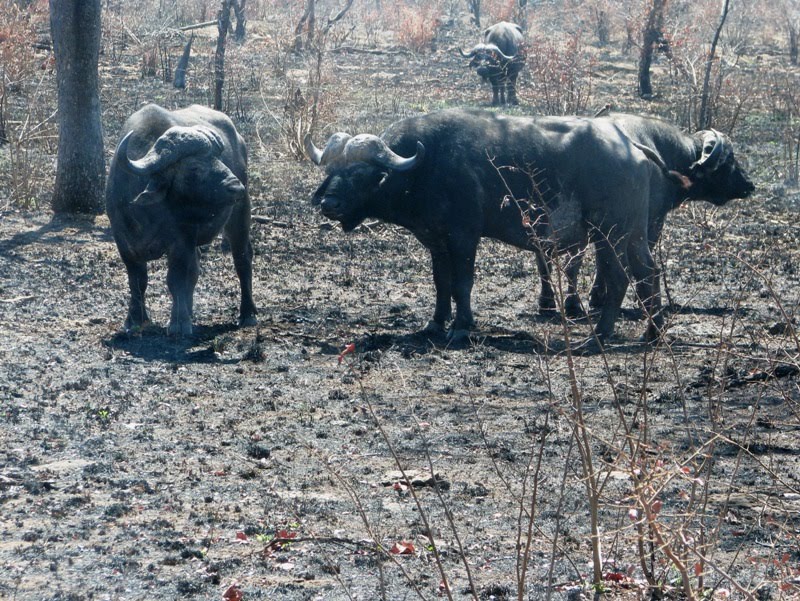 Perhaps the quality of the following photos isn't "the best" (because they were taken through the windows of a tour-bus) but to be "greeted" - right after entering the Kruger National Park - by four old buffalo males (instead of the more common sighting of impala antelopes) caused great excitement.
 Soon after, sighting two lazy rhinos right next to the road, was ample proof that in the Kruger Park, the BIG 5 are "well & alive".
 Observing a herd of elephant probably is one of the most endearing sightings during a game drive & almost appears "unreal" when they come ambling towards you along a road.
By now, we could "tick off" 3 of the BIG 5 - but would we be privileged to also see the 2 cat-species (= the 2 remaining members of the BIG 5)??
Yes, it was one of those lucky days: "out of the blue" a lioness made an appearance . . .
. . . once she lay down & after the original excitement had "died down", we noticed that this female wasn't the only lion around - in the shade of a bush (& to her left) we "discovered" a young male lion. So there were two . . .
. . . no, correction: yet another male lion appeared & settled down next to the other male in the shade of the bush. So we were privileged to "capture" 2 male lions in 1 photo . . .
. . . but then, as if to "even out the equation", yet another lioness joined this group . . .
. . . however that wasn't meant to be the final "count" - lion number 5 had "arrived" . . .
. . . the final scenario: 5 lions "in a row" = 2 females & 3 males = a very unusual sighting, because usually, only 1 male is accompanied by a group of females!
My personal conclusion: the 5 lions probably were young siblings still "experimenting" before 1 or more of the males would set off to find other non-related females to "start" their own "families". In the end we did sight the 5th member of the BIG 5 (= a leopard) but unfortunately, it disappeared too quickly in the thicket for one of us to take a "clear picture". However we had a clear visual of a similarly "dangerous" animal - a young Spotted hyena . . .
  . . . and on a sandbank, an equally "feared" large crocodile.
All in all, a very successful game drive - I will "post" more photos of other & less dangerous, but equally interesting, wild animals, in a "follow-up".
